août 21, 2014
Shorter Downtimes and Reduced Costs
FAG split spherical roller bearings – simple and quick to mount
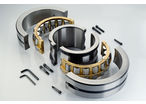
FAG split spherical roller bearings simplify and speed up bearing replacement, particularly in areas that are difficult to access such as shafts with multiple supports. In a split bearing, the inner ring, the outer ring, and the roller and cage assembly are divided into two halves that are clamped together with screws. Using the split version of these bearings allows numerous process steps to be omitted during mounting and dismounting. This means that downtimes can be significantly reduced and correspondingly high cost savings can be achieved. Because the dimensions have been exactly matched, the split spherical roller bearings can be installed in the same space as their unsplit counterparts (including the adapter sleeve). Applications include belt drives, paper machines, ships, conveying equipment, converters, rolling mills, and ventilation-related systems.
Splitting means improvement
In many applications, the spherical roller bearing is mounted on the shaft in such a complex fashion that it is also necessary to remove all the adjacent components in order for it to be replaced. This leads to long downtimes and complex additional tasks such as the removal of gears, clutches, and drive units. Extra costs are also incurred for additional replacement parts, tools, personnel, and even crane rental. When the split bearing version is used, most of these process steps are no longer required and the associated additional costs no longer arise. Mounting and dismounting can be carried out significantly faster and are simplified, especially in bearing positions that are difficult to access. Schaeffler offers split spherical roller bearings for shaft diameters ranging from 55 mm to 630 mm. In most cases, the outside diameter, the outer ring width, and the diameter of the shaft seat match the dimensions of the standard spherical roller bearings, including the adapter sleeve, so the bearings are interchangeable without any problems.
Application example: Installation of a split spherical roller bearing on the exhaust gas fan of a chemical plant
The spherical roller bearing in the exhaust gas fan of a chemical plant, which had an outside diameter of 230 mm, was in need of replacement. In the past, this application employed unsplit bearings that caused a downtime of 14 hours and generated costs of approximately 280,000 euros every time a bearing replacement was carried out. In addition to the immense outlay for the production stoppage, this included the costs for personnel, additional outlay for the alignment of the shaft, crane rental, and a further replacement bearing. With the FAG split spherical roller bearing, the downtime was only three hours and the overall costs 60,000 euros. The additional alignment, the crane rental, and the further replacement bearing were not required. The customer saved around 220,000 euros by using the split bearing.
août 21, 2014
SCHWEINFURT, July 18, 2013. Plain bearings can demonstrate their advantages to the full in marine applications and in the solar and water power sectors, as they have been optimized for the combination of slow swivel movements and high forces that these applications involve. In addition, plain bearings are highly suitable for operation in media such as water and are also suitable for dry running. Schaeffler has systematically expanded its range of plain bearing solutions. In addition to the INA plain bearings with ELGOGLIDE® (both maintenance-free and requiring maintenance) that have proven themselves for several years, the product range also includes metal-polymer composite plain bearings and INA plain bearings with ELGOTEX®.
INA plain bearings with ELGOTEX® WA specifically for marine applications
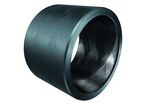
INA plain bearings with ELGOTEX® WA are resistant to sea water and have been specially developed for use as rudder and stabilizer bearings in marine applications, for which they are also certified according to MCM-0112 by Germanischer Lloyd. This design is specifically suitable for water lubrication and therefore does not require a complicated seal of the kind required by conventional rolling and plain bearings.
The ELGOTEX® WA material comprises two layers that are wound onto each other. The internal sliding layer, which is embedded in a resin matrix with fillers and solid lubricants, is made of continuous synthetic and PTFE fibers. The external layer also comprises continuous glass fibers (glass filament) in epoxy resin. A specific winding angle stabilizes the layers, thereby significantly increasing the strength of the bush. A standard range of INA plain bearings with ELGOTEX® WA will be available shortly. Special dimensions deviating from this range are available on request.
A clear advantage of INA plain bearings with ELGOTEX® WA is the increased load carrying capacity compared to the products that are available on the market for use in marine applications. While the standard thus far has been a maximum contact pressure of 10 N/mm2, ELGOTEX® WA can support loads of up to 25 N/mm2. Germanischer Lloyd has certified ELGOTEX® WA for loads of up to 15 N/mm² in marine applications. The higher power density ensures that the operating life of bearings with ELGOTEX® WA can be significantly increased while maintaining the same operating conditions or, alternatively, that bearings with ELGOTEX® WA can support higher loads while maintaining the same operating life values. This opens the door for new design options for downsizing and for reducing the number of different bearing variants used in an application.
Because the plain bearing is self-lubricating in water, there is no need to use oil or grease, and no seals are required. This means a major benefit in ecological terms when used in water.
One plain bearing – many possibilities
The combination of materials makes bearings with ELGOTEX® WA resistant to corrosive media and allows a constantly low friction value with low wear and absolute freedom from maintenance. These bearings have a high radial load carrying capacity, can be used for axial movements, and are insensitive to shocks and edge pressures. They are not sealed, but can be supplied with internal seals for protection against abrasive contamination if required. In addition to their use in marine applications, INA plain bearings with ELGOTEX® WA are also suitable for use in ocean engineering, hydraulic steel constructions, hydroelectric power plants, and in pumps and turbines.
août 21, 2014
Schaeffler has expanded its Competence Center Acoustics within the Technical Development Center in Herzogenaurach by adding an acoustic testing facility. Equipped with state-of-the-art measurement and computer technology, three test rooms and a so-called “wobble room” have been installed in 180 square meters of floor space.
CTO Prof. Dr. Peter Gutzmer is delighted with the new facilities: “This is an audible and tangible further extension of expertise at Schaeffler. With the new Herzogenaurach acoustic center, we have created optimal conditions to further optimize the globally networked development activities at Schaeffler and adapt to customer needs even better than before.”
Especially in the field of drive technology, customers are paying more and more attention to low friction coupled with quiet operation of the individual system components, and this is also true for bearings in electric motors and devices in the home and office environments.
Schaeffler engineers in the Competence Center Acoustics investigate the origins of irritating noise using the latest state-of-the-art analytical methods and give valuable clues as to where and how noise is generated and what can be done to eliminate it right at the beginning of development. Typical tasks include, for example investigations of airborne sound and vibration behavior in the vehicle drive train, as well as in the chassis and its components, such as ball screw drives and roll stabilizers. In addition, the engineers also examine plain bearings and rolling bearings of all types and designs that are used in production machinery, wind turbines and hydroelectric power plants as well as in railway, medical technology or household applications.
Service and development partner for sound testing
Dr. Arbogast Grunau, Senior Vice President Corporate R&D Competence and Service, regards the Schaeffler Group’s acoustic network, which also includes the team at the Competence Center Acoustics in Herzogenaurach, as a service and development partner for all kinds of sound and vibration testing and corresponding optimization: “The expertise concentrated here is the result of long-standing experience in product and system development and it is continuously being developed further.” This ensures that acoustic issues from all areas of automotive and industrial engineering can be addressed quickly and competently. Dr. Grunau adds: “We use our network of competence to spread our knowledge and experience throughout the world, with training and seminars being an important medium. In this way we make an important contribution to Schaeffler’s global alignment, true to our motto ‘Together we move the world’ – here with a particular focus on noise optimization.“
Premises and equipment
“Our extensive equipment includes a high-quality air- and structure-borne sound sensor system, vibrometry, high-speed cameras and several calculating and simulation tools including analysis software,” says Dr. Alfred Pecher, Manager Testing Competence Center Acoustics.
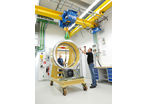
A special feature of the test rooms, which include a large acoustic vehicle test bay, a room for fatigue tests and a shop with extensive adaptation options, is the “room-in-room concept”. Covering a floor space of between 30 and 50 square meters, the rooms are spring-mounted cuboids that can move independently from the rest of the building. This means they are decoupled from the oscillation of the rest of the building. The largest room weighs more than 130 tons. And what’s more: The walls of the interior rooms were required to be of particularly high density (at least 2,400 kg/m³) – special bricks from Sweden were used for this purpose. The interior ceilings and walls of the test rooms are lined with up to 35 cm thick acoustic broadband compact absorbers to meet the sensitive metrological requirements of the acoustic staff.
“Thanks to this constructional measure it has also been possible to reduce noise intruding into the test rooms from outside, such as the sounds of trucks passing by, to a minimum and to obtain technically accurate measurement results,” says Dr. Alfred Pecher.

août 21, 2014
SCHWEINFURT, March 19, 2014. With four new certified Schaeffler Technology Centers (STC), Schaeffler is strengthening its expertise in the regions and is providing even more comprehensive local technical support to its customers. The locations in Santiago (Chile), Seoul (Korea), Sutton Coldfield (England) and Braine L’Alleud (Belgium) were certified in the last few months. 25 Schaeffler Technology Centers worldwide are now providing premium knowledge locally and in immediate proximity to the customer. Schaeffler is gradually expanding its Global Technology Network (GTN) with additional locations.
Certified expertise ensures high standards worldwide
With its local engineers, Schaeffler has always been able to offer a high level of technical knowledge and comprehensive services worldwide. To be awarded the “Schaeffler Technology Center” title and receive the corresponding certificate, however, a location must meet high requirements and global standards. The specified range of services comprises twelve areas of expertise, which are checked in internal audits. With their expert knowledge, the STC engineers can address technical issues quickly and directly. Customers worldwide receive optimum product support for their applications, including important information about operating life, lubrication intervals, mounting tolerances, and assembly services. The portfolio of an STC also includes condition monitoring and defect assessment. Regular training courses, workshops, follow-up audits, and the constant exchange of information with the worldwide networks of experts ensure that this high standard is permanently maintained. Each location places particular focus on individual areas of expertise depending on the regional market requirements. The four new STC, for example, provide an outstanding level of knowledge of assembly services (Chile), condition monitoring (UK), training (Belgium), and application knowledge (Korea).
The Global Technology Network – today and tomorrow
Schaeffler is working continuously on consolidating and expanding the global network. This includes the certification of further Schaeffler Technology Centers and the setup and strengthening of expert networks. 1,250 local engineers at more than 130 sales offices and 25 Schaeffler Technology Centers are currently providing optimum local support to customers. They are assisted by 1,000 sector and product experts and 6,000 R&D engineers. Schaeffler will also develop expertise and initiate the STC certification process at other locations depending on the market requirements.
août 21, 2014
HERZOGENAURACH/SCHWEINFURT, April 16, 2014. In order to fulfill customers‘ ever-increasing demands, Schaeffler is continuously updating and expanding its long-established Bearinx® rolling bearing calculation program. In addition to products with optimized friction and performance characteristics, modern calculation and simulation tools play a key role in increasing the efficiency of rolling bearings.
With “Bearinx®-online Easy RopeSheave”, every Schaeffler customer can now calculate the static load safety factor and rating life of both single and multiple rope sheave bearings. It is available exclusively online and can be used free of charge. Initial registration takes very little time and the customer can begin calculation work immediately.
New: The “Easy series” for online customers
Customers can quickly and safely browse through and compare a range of bearing support variants at http:\\bearinx-online-easy-ropesheave.schaeffler.com. The self-explanatory menu navigation enables users to enter data quickly and easily for modeling, bearing selection, and operating data.
The data for radial roller bearings, radial deep groove ball bearings, and radial tapered roller bearings from the INA and FAG brands are stored in the database and can be accessed and integrated into the calculation process at any time. Influencing factors that are typical for the application, such as consideration of the rope sheave material, the integration of a bush between the bearing and plastic rope sheave, precise data on the bearing’s internal geometry, and the influence of the system temperature on the bearing clearance are also relevant for the calculation.
Extra module for rope sheave bearing supports
Bearinx® enables users to calculate, display, and document the specific bearing loads in detail while taking operating and environmental conditions into consideration – even for complex machine systems. The contact pressure on every single rolling element is considered in the calculation. There is a dedicated module for rope sheave bearing supports that allows even several adjacent rope sheaves to be calculated precisely. Bearinx® takes into account factors such as the non-linear elastic deflection behavior of the rolling elements, contact angle shifts in radial ball bearings caused by the load, the elasticity of the axis, and the real contact pressure depending on the skewing and profiling of the rolling elements.
The saved files can be exchanged with Schaeffler’s Engineering Service, who can then carry out a final inspection. The objective is to offer the customer optimized and efficient support in his or her own product development at all times and, in doing so, shorten development times wherever possible. The program’s outstanding performance, combined with the specialist knowledge of Schaeffler’s application engineers and the customers’ practical experience, generates innovative and technically sophisticated solutions.
février 23, 2012
After a design and construction phase of less than 2 years, Schaeffler officially put the world’s largest, most up-to-date and most powerful large-size bearing test stand into operation at its Schweinfurt plant on Wednesday. The test stand enables large-size bearings of up to 15 tons and measuring up to 3.5 meters such as those used in wind power applications in particular to be tested in realistic conditions using a comprehensive simulation program. This means Schaeffler is making a major contribution to shortening development times for wind turbines as well as making the design process more reliable and increasing the cost-effectiveness and safety of these turbines. At around €7 million, the Schaeffler large-size bearing test stand is a significant investment in the further development of renewable energies and the company’s development location in Schweinfurt.
The new test stand will primarily be used for testing rotor bearing supports for wind turbines in the multi-megawatt class and will result in further improvements in the understanding of systems as a whole, influencing factors and the interrelations in the drive trains of wind turbines. This will result in bearings characterized by lower friction and increased design safety. In addition, the tests will provide information about and recommendations for wind turbine operation and maintenance as well as for optimum adjacent constructions. The test stand has been named “Astraios” after a Titan in Greek mythology who was father of the four wind gods.
Schaeffler is perfectly prepared for the opportunities presented by the energy revolution
For Maria-Elisabeth Schaeffler, partner in the Schaeffler Group, the test stand symbolizes both the immense tasks facing us in the future and the core values of the company: Innovative strength and pioneering spirit, performance, quality awareness, and loyalty to its locations. Her welcoming speech highlighted the opportunities that the energy revolution presents, especially for the machine construction and plant engineering sectors. “For Schaeffler, this large-size bearing test stand represents a consistent step towards further strengthening the strategic growth area that renewable energies represent”, Mrs. Schaeffler explained.
Dr. Anja Weisgerber, MEP and member of the Environment Committee of the European Parliament, emphasized Schaeffler’s top technological position in the wind power sector and expressed thanks on behalf of Schweinfurt's mayor Sebastian Remelé and the city council members in attendance for the investments the company has made in its development location in Schweinfurt. She added that one of the central tasks for politicians is to increase support for research and development in the renewable energy and energy storage technology sectors, and to expand the network infrastructure even beyond the national borders.
The necessity of rapid international network expansion was also highlighted by Heiko Roß, Technical Director of Windreich AG, a company that plans, constructs, finances, and operates wind turbines and has installed over 1,000 onshore wind turbines to date. The biggest growth area is the offshore region in Germany’s portion of the North Sea. “This sector in particular is one that requires absolutely reliable technology”, explains Mr. Roß. “And Schaeffler’s test stand establishes the prerequisites for this to be achieved.”
According to Dr. Juergen M. Geissinger, CEO of Schaeffler AG, the company is well prepared to face the global challenges presented by renewable energies thanks to its innovative products and technologies, as well as its position on the growth markets. “In addition to wind power, solar power and wave and tidal power are also becoming increasingly important, and our solutions play a very significant part in making these new technologies reliable and cost-effective, Dr. Geissinger added.
Setup and function of the large-size bearing test stand
The test stand carries out realistic simulations of static and dynamic forces and torque that act on the rotor bearings and slewing rings, for example. All rotor bearing support concepts for wind turbines with an output of up to 6 megawatts can be tested on the test stand. Functional tests provide insights into the rolling bearing kinematics, temperature and friction behavior, loads and deformation. The data required for these tests is supplied by more than 300 sensors on and in the bearings.
The loading frame is the test stand’s most important component. Four radial and four axial hydraulic cylinders are fixed to the frame, which generate the real loads and moments that occur in a wind turbine. The radial cylinders simulate the weight of a rotor hub with rotor blades while the axial cylinders generate the wind loads.
The rotors and hub in large turbines can weigh well over 100 tons. This weight acts on the bearing and generates a so-called static radial load and a static nodding moment. Accordingly, the four radial cylinders have impressive dimensions, since each cylinder can generate a maximum of one meganewton of force, which is equivalent to 100 tons of weight. The axial cylinders have even more “power, since they can provide up to 1.5 meganewtons for simulating the static axial load as well as the dynamic nodding and yawing moments. This nodding and yawing is comparable to the lifting and lowering and turning of the nacelle.
Various wind speeds can be simulated using the drive train and planetary gearbox. Typical speeds are between four and 20 revolutions per minute and significantly higher speeds are also possible. The tensioning frame represents the connection side of the wind turbine's nacelle. It’s a well-known fact that the wind seldom blows at the same speed or from the same direction. In fact, it acts with varying intensity and at different points on the wind turbine. Varying moments are generated on the rotor hub, depending on the position of the rotating rotor blades. If, for example, the wind acts on the top or bottom of the rotor blades, it generates the so-called dynamic nodding moment. This is supplemented by so-called dynamic yawing moment if the wind turns and blows more strongly from the side.
These factors all mean that wind turbines are subject to extremely complex conditions due to the continuously changing wind conditions. This is a Herculean task, not only for the test stand and the 8 hydraulic cylinders that simulate all real loads and moment, but also for SARA that automatically controls the comprehensive measurement, open loop and closed loop control processes. SARA stands for Schaeffler Automation System for Research & Development Applications. SARA generates the target values in accordance with the wind loads, controls the highly-dynamic servo cylinders, controls all units, ensures all data is measured and stored, is responsible for telemetric bearing measuring technology, displays all target, actual and limit values, evaluates measured data, and generates logs
Buyers
Find your suppliers Complete your request and let our teams find you the best deals available.Suppliers
Find your future clients List your products and services to enhance your web presence and receive qualified enquiries.