SPAD Data Mining: a complete suite for exploration
and predictive analysis
SPAD Data Mining software includes all the functions of the SPAD Profiling and SPAD Scoring softwares, integrating and completing the Interactive Decision Trees and the analysis of multiple tables (K tables).
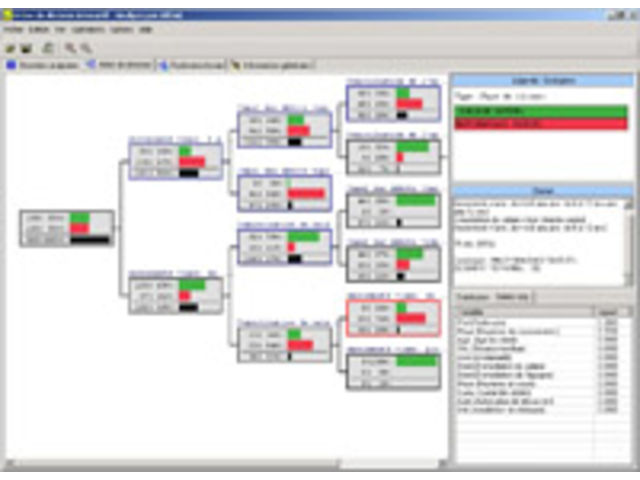
Decision Trees are a powerful alternative to the classical techniques of Regression and Discriminant Analysis. They can express results as easily interpreted rules, which can be stored and applied later on other data sets, in particular as requests on large databases.
Interactive Decision Trees:
· CART, CHAID, C4.5 Methods
· Validation by test-sample (random draw or defined by a variable), crossed validation (for small samples)
· Output of equi-reducing and equi-dividing variables
· Cost matrix for bad classification, a priori probabilities
· Criteria for termination: number of tree levels, minimum count to divide a segment, specialisation threshold
· Automatic or interactive analysis
· Modification of the tree :
· Manual tree pruning
· Choice of variables to cut
· Go up or go down a tree level
· Regroup modes, threshold value of a continuous variable
· Visualization :
· View the full tree with zoom in/out
· Local exploration of a segment and graphical comparison with the full population
· Data view with training samples, test sample, pruning sample
· General characteristics of the tree and Confusion Matrix
· Output of a full report on the tree in html format
· Output of decision rules in Select or Update mode in SQL format according to the Database System (Oracle, Access etc.)
Multiple Tables - K Tables:
It is not usualto have available not just a single data table, but the same table at repetitive dates, ie : the tables of the results of the different members of a jury for the sensorial analysis etc. Knowing how to extract the best from a data table is good ! Even better, is to be able to exploit several tables linked together!! This adage characterizes both the STATIS method and the MFA method.
.
· Multiple Factorial Analysis (MFA)
· Exploration of data beyond the classical data analyses by exploiting ''Groups of Variables''
· Groups of active/illustrative, nominal or continuous variables
· Partial factorial analyses and Global factorial Analysis
· A powerful and interactive Graphics editor
· STATIS
· Alternative to AFM
· STATIS methods, Dual STATIS and Jaffrenou's Triadic
· Groups of continuous active variables
· Temporal analysis and evolution of the battery of indicators
· A powerful and interactive graphics editor

 All you need to run your factory !